Sunday, March 18, 2012

Sir Norman Haworth

Walter Norman Haworth was born on March 19, 1883 in Chorley, Lancashire, England the second son and fourth child of Thomas and Hannah Haworth. His father was the manager of a linoleum plant. After attending the local school until the age 14 Haworth joined his father and learned about linoleum design and manufacture. His interest in chemistry began when he studied the dyes used to color linoleum. He continued his education studying under a tutor in the neighboring town of Preston, which allowed him to pass the entrance examination for the University of Manchester. Against his family's wishes he began at the University of Manchester, studying chemistry under W.H. Perkin. He graduated with first class honors in 1906. On the basis of his work under Perkin he was awarded a 1851 Exhibition Scholarship which allowed him to study in the laboratory of Otto Wallach in Gottingen, Germany earning his doctorate in one year of study. He returned to Manchester where in the minimum time possible he was awarded his D. Sc. for his work on terpenes. Terpenes are produced by plants and their building block are units of isoprene.

In 1911 Haworth took an appointment as a demonstrator at the Imperial College of Science and Technology in London and in 1912 he was appointed a lecturer at the University of St. Andrews in Scotland. At St. Andrews he became interested in the chemistry of carbohydrates while working with Thomas Purdie and James Irvine. Haworth organized the laboratories at St. Andrews for the production of chemicals and drugs during the First World War. In 1920 he was called to take the chair of chemistry at the University of Durham. The following year he succeeded Philips Bedson as director. In 1925 Haworth was appointed professor and director of chemistry at the University of Birmingham where he remained until 1948. Then he became the dean of science and he served as an acting vice-principal from 1947 to 1948.

Haworth's research centered around carbohydrates and he determined the structures of many, including maltose, cellobiose, lactose, gentiobiose, melibiose, gentianose, and raffinose. He was also responsible for discovering the glucoside ring structure of normal sugars. Normal sugars that are five or six carbons long form a ring structure where the terminal hydroxyl nucleophillically attacks the aldehyde carbon forming an glycosidic bond. He developed Haworth projections which are two dimensional representations of three dimensional sugar structures. Haworth was also the first person to chemically synthesize vitamin C, the first vitamin artificially synthesized.

For his work understanding the structures of carbohydrates and the synthesis of vitamin C Haworth shared the 1935 Nobel Prize in Chemistry with Paul Karrer. In 1947 Haworth was knighted. In 1977 the Royal Mail issued a postage stamp honoring Haworth for his Nobel Prize and the synthesis of Vitamin C.

He died suddenly on his 67th birthday, March 19, 1950.


References:

Anon, "Walter Norman Haworth: 1883-1950" in Advances in Carbohydrates(1951)6:1

Norman Haworth Nobel Biography

Norman Haworth Wikipedia Entry

Sunday, March 11, 2012

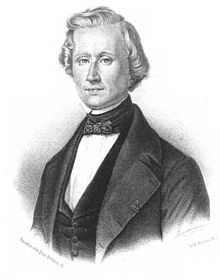
Urbain Jean Joseph LeVerrier


Urbain Jean Joseph LeVerrier was born in St. Lo in Normandy, France on March 11, 1811. As a boy he showed an aptitude for mathematics when he attended school in Caen, but he was turned down from the prestigious Ecole Polytechnique in Paris. In order to help his son, his father sold the family home so that LeVerrier could attend the College de St. Louis in Paris. A year later, when LeVaerrier reapplied to the Ecole Polytechnique his application was accepted, winning the mathematics prize. LeVerrier graduated in the top of his year and briefly took a job working for the chemist Joseph Gay-Lussac.

In 1837 he returned to the Ecole Polytechnique as an astronomy assistant. His first major piece of work was looking in to the stability of the solar system. In 1840 Dominique Arago, the director of the Paris Observatory, suggested he look into the motion of Mercury, which he did. LeVerrier predicted the start of the transit of Mercury of May 1845 to within 16 seconds. Next Arago had LeVerrier look in to the motion of Uranus, which was not moving as predicted. LeVerrier calculated that the perturbations of Uranus' orbit were due to the presence of another planet, further from the sun than Uranus. Unknown to Arago and LeVerrier, in England, John Crouch Adams had previously reached the same conclusion. Adams had sent his work to George Airy, the royal astronomer and James Challis, the director of the Cambridge Observatory. Neither man acted on Adams' findings until after LeVerrier had published his work in June of 1846. After LeVerrier published, Airy attempted to observe the planet, but it was not seen until September of 1846 when what would be named Neptune was observed by Johan Galle and Heinrich d'Arrest in Berlin.

In 1849 he was elected to the French Legislative Assembly. In 1852 he was appointed a senator and member of the Superior Council of Public Instruction on which he served until 1870. When Arago died in 1854, LeVerrier became director of the Paris Observatory. He was removed as director in 1870 but was reinstated in 1873. He was awarded a gold medal by the Royal Society of London in 1868 and 1876. He has craters named after him on the Moon and on Mars and he is one of the 72 names inscribed on the Eiffel Tower.

He died in Paris on September 23, 1877.


References:

Anon.;"Urbain-Jean-Joseph LeVerrier" in Proceedings of the American Academy of Arts and Sciences(1978)13:454-455

Dunkin, E. "M LeVerrier" in The Observatory (1877)1:199-206

Leverington, David; Babylon to Voyager: A history of Planetary Astronomy; Cambridge University Press; 2003

Urbain LeVerrier Wikipedia Entry


Sunday, March 4, 2012

George Gamow

Georgiy Antonovich Gamov was born on March 4, 1904 by cesarean section on a table in his father's library in Odessa then part of the Russian Empire (now in Ukraine). Both of his parents were teachers; his father taught Russian language and literature at a boys school and his mother taught geography and history at a girls school. His maternal grandfather was the archbishop of Odessa and his paternal grandfather was a commander in the Russian Army. At age six he saw Halley's comet from the rooftop of his family's building and from astronomy he became interested in physics. The Russian Revolution struck while he was a student at the school where his father taught which was frequently closed due to street fighting. He graduated in 1920 and went on to Odessa State University, but was unable to study physics there due to the privations caused by the revolution. In 1923 he went to the University of Leningrad (now St. Petersburg State University). There he studied under Alexander Friedman, however Friedman died in 1925.

While studying conventional physics at the university Gamow met with other students to read the papers coming from western Europe that were defining the new science of quantum mechanics. Gamow was interested in the new theories and sometimes neglected his studies in classical physics. In 1928, after being admonished for unsatisfactory academic progress, he was given a fellowship which allowed him to go to Germany. Gamow traveled to Gottingen, where he studied under Max Born at the Institute for Theoretical Physics. While there he authored a paper explaining why radioactive nuclei emit low energy alpha particles, but when bombarded by alpha particles of higher energy they are not incorporated by the nuclei. Alpha particles are a product of radioactive decay composed of two protons and two neutrons, a helium nuclei. After four months in Gottingen Gamow's money ran out and he headed home. On the way back to Russia he stopped in Copenhagen, Denmark where he ended up staying for eight months. While there he had the chance to present a paper to the Royal Society of London, quite an honor for a 25 year old scientist.

After Gamow returned to the Soviet Union he decided to leave due to the increased political repression. In 1932, after three aborted attempts to defect, which were not noticed by the authorities, he was granted passports so that he and his wife, Rho, could go to a conference in Brussels. After the conference Gamow tried to find work in Europe. He did get a few temporary positions but it was not until 1934 that he could find a permanent position at George Washington University in Washington D.C. In 1940 Gamow was naturalized as a U.S. Citizen. He remained at George Washington University until 1956. Despite his knowledge of atomic physics during the Second World War he did not work on the Manhattan Project, but stayed at Washington University and did some consulting for the United States Navy. In 1954 he became a visiting professor at the University of California at Berkeley and in 1956 he took a position at the University of Colorado at Boulder, where he remained for the rest of his career.

Gamow studied beta emission, the emission of an electron by a radionuclei and nucleosynthesis, the creation nuclei larger than a single proton (hydrogen) inside stars. Stars are powered by atomic reactions such as hydrogen forming helium and releasing energy. Helium, with its two protons and two neutrons, then is used to form even numbered atomic elements (beryllium, carbon, and oxygen). Gamow worked to popularize the big bang theory, the theory that the universe and all the matter in it was created in a big bang. Gamow's most important work in astrophysics was on understanding the generation of red giants, stars that have exhausted the supply of hydrogen at their core. When the reaction producing helium stops the core collapses due to gravity. The conversion of hydrogen into helium continues in the region surrounding the stellar core, which expands creating a red giant star. After the 1953 discovery of the structure of DNA Gamow attempted, unsuccessfully, to solve the problem of how the genetic code translates into proteins. Gamow was also an award winning writer of both scientific and popular books. The physics tower at the University of Colorado, in Boulder is named after him.

Gamow died on August 19, 1968.


References:

Interview with George Gamow by Charles Weiner on April 25, 1968. Neils Bohr Library and Archives, American Institute of Physics; online at aip.org

Hufbauer, Karl; "George Gamow: 1904-1968" in Biographical Memoirs; National Academy Press; 2009

George Gamow Wikipedia Entry

Sunday, February 26, 2012

Joseph LeConte

Joseph LeConte was born on February 26, 1823 on the plantation "Woodmanston" in Liberty County, Georgia. He was the fifth child and youngest son in the family. His mother died of pneumonia when he was three. His father, who had trained as a doctor, but did not earn a degree, ran the family plantation and set up a chemical laboratory in his house and a botany garden for the education of his sons. As a boy LeConte frequently ranged the backwoods of Liberty County with his older brothers and took an interest in nature. He attended a country school set up by several of the plantation families and among his teachers was Alexander Hamilton Stephens, who was later a U.S. Senator and vice-president of the Confederacy, and with whom he maintained a lifelong friendship.

He attended Franklin College which later founded the University of Georgia in Athens, Georgia. He graduated in 1841. After graduation he began studying medicine under Charles West in Macon, Georgia and then he attended the New York College of Physicians and Surgeons, graduating with a medical degree in 1845. He practiced medicine for three years in Macon, Georgia and then studied history at Harvard University, in Boston, Massachusetts, studying under Louis Agassiz. After graduation in 1851, he accompanied an expedition lead by Agassiz to the Florida Reef. After the expedition he became a professor of natural science at Oglethorpe College in Midway, Georgia. From 1852 to 1856 he was a professor of natural sciences and geology at Franklin College and from 1857 to 1869 he was a professor of chemistry and geology at South Carolina College (later the University of South Carolina) in Columbia, South Carolina. During the American Civil War he continued teaching, but also ran a niter works used to produce explosives. In 1869 he moved to California, taking a job as the first professor of natural history and geology at the newly founded University of California, at Berkeley. He remained there until his death.

LeConte was primarily a geologist but he also wrote papers on monocular and binocular vision. He was also an early proponent of Charles Darwin's theory of natural selection. LeConte was one of the early supporters of the theory of contraction formation of mountain ranges. The theory was that when the earth was formed it was a molten ball  and as it cooled ridges on the surface developed. These ridges are the mountain ranges we see today. This theory of mountain range formation has been replaced by plate tectonic theory. LeConte was also an ardent conservationist. He was friends with John Muir, and with Muir was a co-founder of the Sierra Club. In 1874 he was nominated to the National Academy of Science. He served as president of the American Association for the Advancement of Science in 1892 and president of the Geological Society of America in 1896.

He died on July 6, 1901 of a heart attack, while in Yosemite Valley. He was to be leaving on a Sierra Club trip the next day.


References:

LeConte, Joseph; "The Autobiography of Joseph LeConte", edited by William Dallam Ames; D. Appleton and Company; 1903

Hilgard, Eugene W.; "Biographical Memoir of Joseph LeConte: 1823-1901"; in Biographical Memoirs; National Academy Press; 1907

Joseph LeConte Wikipedia Entry

Sunday, February 19, 2012

Svante August Arrhenius

Svante August Arrhenius was born on February 19, 1859 in Vik, a village near Uppsala, Sweden. His father, Svante Gustaf Arrhenius, was a land surveyor who worked for the University of Uppsala. The family moved to Uppsala in 1860. A gifted child, Arrhenius learned to read from lessons given by his older brother Janne. He learned to do arithmetic by watching his father keeping the accounts that he was responsible for. At age 8 he entered the local cathedral school, starting in 5th grade. He excelled at mathematics and physics, graduating as the youngest and most able student in 1876. In the autumn of 1876 Arrhenius entered the University of Uppsala, where he studied mathematics, physics and chemistry. He finished his bachelors in January 1878, finishing in a year and a half, a record at the time.

After a trip to Paris, he began his graduate studies in physics at the University of Uppsala, but due to the poor instruction he moved to Stockholm, studying under Erik Edland at the Physical Institute of the Swedish Academy of Sciences. Arrhenius began working for Edland studying electrical spark discharges, but moved on to studying the dissolution of electrolytes in water. Electrolytes are chemicals that when added to water make a solution that conducts electricity. Arrhenius discovered that electrolytes, when dissolved in water, break up into negatively and positively charged particles called ions. His thesis was not well received by his professors and was given the lowest possible passing grade.  Only after his defense was it raised to a third class rating.

 Arrhenius sent his thesis to two of the leading physical chemists of the time, Jacobus van't Hoff and Wilhelm Ostwald. Ostwald was so impressed that after some correspondence he traveled to Uppsala to offer Arrhenius a docent position in Riga, which at that time was part of the Russian Empire. Arrhenius decided to stay in Sweden and he was given an unpaid docent position at the University of Uppsala, the first such position in the emerging science of physical chemistry. In 1885, with the recommendation of Edland he received a traveling fellowship from the Swedish Academy of Science that allowed him to travel through Europe and work with prominent physical chemists. In 1886 he traveled to Riga to work with Ostwald and to Wurzburg to work with Friedrich Kohlrausch. In 1887 he traveled to Graz to work with Ludwig Boltzmann and in 1888 he traveled to Amsterdam to work with van't Hoff. During these trips he studied the effects of ions in solution, including the increase in the boiling point and lower the freezing point of ionic solutions versus pure solvents and the effects of ions in digestion and in the interaction of toxins and anti-toxins.

It was not until 1891, after he refused the offer of a professorship in Giessen, Germany, that he was made lecturer at Stockholm University College and in 1895 he was appointed professor of physics. In 1886 after studying the causes of ice ages he published a paper linking atmospheric carbon dioxide levels and rising temperatures. He calculated that if the level of carbon dioxide in the atmosphere doubled the temperature would rise by 5o-6oC. Scientists today say that it is really only a 2o-3oC rise in temperature. This rise in temperature is caused by the infrared absorption of carbon dioxide. The sun's rays warm the earth and it cools by releasing infrared radiation. This radiation is absorbed by carbon dioxide in the atmosphere and reflected back to earth, preventing it from escaping back into space. This is called the greenhouse effect, where carbon dioxide in the atmosphere keeps the earth warm by preventing heat from escaping. The cumulative effect of carbon dioxide and other greenhouse gasses give rise to global warming.

Around 1900 Arrhenius became involved with the Nobel Prize. In 1897, with the death of Alfred Nobel, the Swedish scientific establishment was left with the task of organizing the bequest from his will, prizes awarded to outstanding achievements in chemistry, medicine, physics, economics, literature, and peace that benefit mankind. Arrhenius was largely responsible for setting up the rules that govern the prizes. In 1903 he won the Nobel Prize for Chemistry for his work on the "electrolyte theory of dissociation". This was partly work he had done on his doctoral dissertation that only earned third class honors. Other honors he won include election as a foreign member to the Royal Society of England in 1911, the Society's Davy Medal and the Faraday Medal given by the Chemical Society, as well as many honorary doctorates.

Arrenius spent his later years writing  scientific textbooks and science books for a lay audience and he died on October 2, 1927 in Stockholm. He was buried in Uppsala.


References:

Arrhenius, Gustav; Caldwell, Karen; and Wold, Svante; "A tribute to the memory of Svante Arrhenius (1859-1927)"; The Royal Swedish Academy of Engineers (2008)

Sample, Ian; "The Father of Climate Change"; The Guardian; June 30, 2005

Svante Arrhenius Wikipedia Entry

Svante Arrhenius Nobel Biography


Sunday, February 12, 2012

Marcel Gilles Jozef Minnaert

Marcel Gilles Jozef Minnaert was born on February 12, 1893 in Burges, Belgium. His father and mother were school teachers, liberal and supportive of Flemish causes. Minnaert, in his youth was influenced by his uncle, Gerard Minnaert, who was important in the Flemish movement. He grew up in a part of Belgium where Dutch was the common language but all the schools taught in French. After his father's death in 1902 his mother moved the family to Gent, Belgium. Minnaert went to secondary school in Gent and then to the University of Gent, where he studied natural sciences, particularly biology. While a student he was part of a movement to change the language of the university from French to Dutch. He earned his doctorate in biology in 1914.

In 1915-16 he spent a year in Leiden in order to study mathematics and physics. During the German occupation of Belgium he taught physics at the University of Gent, but was forced to flee in 1918, when the Germans left, because he was seen as a collaborator. He relocated to the University of Utrehct, in the Netherlands, where he worked for W.H. Julius who stimulated his interest in solar physics. He finished his second doctorate, this time in astronomy in 1925 the same year that Julius died. Minnaert replaced Julius as the director of the solar spectrograph research project at Utrecht. This was a fascinating time in stellar physics when atomic physics could finally explain what was really happening. Stars, like our sun, are fusing nucleons together, creating new atoms, making the matter that we are made of.

In 1928 he led a successful solar eclipse expedition. In 1940 he published the Utrecht Atlas of the Solar Spectrum and in 1941 he developed the Minnaert function, which is used in the observation of celestial bodies. In 1942, Minnaert, who never hid his liberal political views was taken prisoner by the Germans. He taught physics to his fellow prisoners while he was imprisoned. He was released in 1944. After the war, he returned to the University of Utrecht's observatory and remained director until his retirement in 1963. In addition to his astronomical writings Minnaert also published a physics book that was popular in the Netherlands and was translated, and also a book of poetry dealing with astronomical subjects. Honors won by Minneart include the Bruce medal, presented by the Astronomical Society of the Pacific in 1951 and a gold medal from the Royal Society of London, in 1947. Minneart also has a crater on the moon and an asteroid named after him.

Mineart died on October 26, 1970.


References:

De Jager, C.; "In Memoriam: Marcel Gilles Jozef Minnaert (12 Februarty 1893-26 October 1970)"; Astrophysics and Space Science(1971)10:83-85

Unsold, Albrecht;"In Memorian: Marcel Gilles Jozef Minnaert";Solar Physics(1971)17:3-5

Anon; "Biographies: Marcel Gilles Jozef Minnaert"; online at www.dwc.knaw.nl

Marcel Minnaert Wikipedia Entry


Sunday, February 5, 2012

Sir Alan Lloyd Hodgkin

Sir Alan Lloyd Hodgkin was born on February 5, 1914 in Banbury, Oxfordshire, England. His family were Quakers and his pacifist father, George, died of dysentery in Baghdad while on a relief expedition to help Armenia refugees in 1918, when Hodgkin was 4. Hodgkin was raised by his mother. As a young boy he took an interest in natural history, wandering in the Oxford countryside. He attended the Downs School and Gresham's School, winning a scholarship to Trinity College, Cambridge, where he studied zoology, chemistry and mathematics. He graduated from Trinity in 1936. After graduation he did fellowships at Trinity and the Rockefeller Institute in New York.

Returning to Cambridge in 1939, he began working with his students Andrew Huxley and Richard Keynes studying nerve cell activation, but with the outbreak of World War II the research was temporarily abandoned. Hodgkin briefly worked in aviation medicine in Farbourough, England, but then transferred to the Telecommunications Research Establishment where he worked on radars for fighter planes. After the war he returned to Cambridge where he lectured in physiology and was appointed assistant director of research. He  continued researching nerve cells and Huxley and Keynes returned to work with him. They also worked part time at the Laboratory of the Marine Biological Institute in Plymouth where they used giant squid nerves for their research..

The research that they were doing involved the changes in nerve cell membrane ion permeability before, during, and after nerve excitation. Using nerve cells from giant squid they established that during nerve excitement, ion channels in the membrane open allowing sodium ions to flow through the cell membrane into the cell and potassium to flow out.  This flow of ions moves down the length of the nerve cell, conducting an electrical signal. This is the way excitable cells like muscle and heart cells, as well as nerve cells, activate. Later research showed that there were protein ion channels in the cell membrane that allow ions to flow across the membrane. For their work in describing nerve cell action potentials Hodgkin and Huxley, as well as Sir John Eccles, shared the 1963 Nobel Prize for physiology and medicine.

Other honors won by Hodgkin include, election to the Royal Society in 1948, the Foulerton Research Professorship in 1951, and the Copley Medal from the Royal Society in 1965. He served as the president of the Royal Society from 1970 to 1975, as chancellor of Leicester University from 1971 to 1984 and master of Trinity College from 1978 to 1984. He was knighted in 1972 and appointed to the Order of Merit in 1973.

Hodgkin died on December 20, 1998.


References:

Hodgkin, Sir Alan L.; "Sir Alan L. Hodgkin"; in The History of Neuroscience in Autobiography, Volume 1; The Society for Neuroscience; 1996

Anonymous; "Nobel Prize Winning Biologist Dies, Aged 84"; BBC News; December 20, 1998

Alan L. Hodgkin Nobel Biography

Alan Lloyd Hodgkin Wikipedia Entry