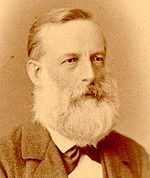
Julius Lothar Meyer was born on August 19, 1830 in Varel, which at the time was part of the Dutchy of Oldenburg, and is now part of Germany. He was the fourth of seven children of a physician and his wife. He began his education with the intention of following his father in his career choice and after high school he studied medicine first at Zurich University and then at the University of Wurzburg. He qualified in medicine in 1854. After graduation, interested in physiological chemistry, Meyer worked at the University of Heidelberg, where Robert Bunsen was the chemistry department chair. He earned his Ph.D. from the University of Breslau in 1858, completing a thesis on the action of carbon monoxide on blood. The following year he became a privat-docent in physics and chemistry at Breslau. In 1866 Meyer became professor of chemistry at Karshule Polytechnic and in 1876 he became the first professor of chemistry at the University of Tubingen, where he remained until his death.
Meyer is chiefly remembered for his contributions to the development of the periodic table of elements. In 1864 Meyer published Die Modernen Theorie der Chemie, a chemistry textbook that went through five editions and was translated into English, French, and Russian. Included in the book was a table of 28 elements arranged by increasing atomic mass. Meyer was the first to identify the periodic (repeating) nature of the elements. Periodicity means that chemical elements of different sizes can have similar properties and those properties are repeating in that elements listed on the periodic table in groups (vertical columns) have similar chemical properties. Meyer's publication preceded Dimitri Mendeleev's periodic table (from which the modern periodic table was developed) which was not published until 1869. Like Mendeleev's table Meyer's table has empty spaces for elements that had not been discovered yet.
Meyer is also known for being the first to predict that benzene had a cyclic shape, although he did not predict the alternating single/double bonds found in benzene, that were later described by August Kekule. In 1882, Meyer (with Mendeleev) was awarded the Davy Medal by the Royal Society of London.
Meyer died on April 11, 1895.
References:
The Royal Society of Chemistry: "Julius Lothar Meyer -- The First Identifier of Periodicity?"; retrieved from rsc.org
Daintith, John; "Meyer, Julius Lothar" in the Biographical Encyclopedia of Scientists, Third Edition; CRC Press; 2010
Scerri, Eric; A Tale of Seven Elements; Oxford University Press; 2013
Julius Lothar Meyer Wikipedia Entry
Showing posts with label periodic table. Show all posts
Sunday, August 18, 2013
Sunday, January 20, 2013
Alexandre-Emile Beguyer de Chancourtois
Alexandre-Emile Beguyer de Chancourtois was born on January 20, 1820 in Paris, France. At eighteen he began attending the school of mines at the Ecole Polytechnique. After completing his studies he joined a geological expedition to Turkey, Hungary, and Armenia. When he returned to Paris in 1848 he took a teaching position at the Ecole Nationale Superieure des Mines de Paris. He became a professor of geology in 1876. In 1875 he became the inspector of mines for France, a position he maintained until his death. As inspector of mines he introduced many safety measures including those to prevent a methane explosion.
He is best remembered for being the first to organize chemical elements into a system based on chemical similarities. Using the atomic masses obtained by Stanislao Cannizzaro, he developed a table of sixteen units, the atomic mass of oxygen, that wrapped around a cylinder, like the thread of a screw. This system was not widely accepted by chemists because when it was originally published the printer did not understand the cylindrical system so there was no diagram printed and when it was later published in a geological journal it was ignored by chemists. The idea that chemical elements have periodic properties or chemical similarities as atomic mass increases eventually was developed by Dimitri Mendeleev into the first periodic table which was able to predict properties of yet undiscovered elements. The periodic table used today is based on that of Mendeleev.
He died on November 14, 1886 in Paris.
References:
Fuchs, Edmond; "Obituary Notice on MA-E Beguyer de Chancourtois, Inspector General of Mines"; Retrieved from: http://www.annales.org
Strathern, Paul; Mendeleev's Dream: the Quest for the Elements; Macmillan; 2001
Alexandre-Emile Beguyer de Chancourtois Wikipedia Entry
He is best remembered for being the first to organize chemical elements into a system based on chemical similarities. Using the atomic masses obtained by Stanislao Cannizzaro, he developed a table of sixteen units, the atomic mass of oxygen, that wrapped around a cylinder, like the thread of a screw. This system was not widely accepted by chemists because when it was originally published the printer did not understand the cylindrical system so there was no diagram printed and when it was later published in a geological journal it was ignored by chemists. The idea that chemical elements have periodic properties or chemical similarities as atomic mass increases eventually was developed by Dimitri Mendeleev into the first periodic table which was able to predict properties of yet undiscovered elements. The periodic table used today is based on that of Mendeleev.
He died on November 14, 1886 in Paris.
References:
Fuchs, Edmond; "Obituary Notice on MA-E Beguyer de Chancourtois, Inspector General of Mines"; Retrieved from: http://www.annales.org
Strathern, Paul; Mendeleev's Dream: the Quest for the Elements; Macmillan; 2001
Alexandre-Emile Beguyer de Chancourtois Wikipedia Entry
Subscribe to:
Posts (Atom)