Showing posts with label astronomy. Show all posts

Sunday, March 9, 2014

David Fabricius

David Fabricius (the Latinization of David Farber or David Goldschmidt) was born on March 8, 1564 in Essens, Frisia, which now is part of Germany. Fabricius attended Latin school in Braunschweig and attended the University of Helmstedt where he studied theology. Fabricius was a Lutheran minister and served as a pastor in towns in Frisia (now northeast Netherlands and northwest Germany). In addition to being a pastor Fabricus was an astronomer.

Fabricius is most remembered for being the first to observe a variable star, the variable star later named Mira. A variable star is a star whose brightness, as observed from earth, changes over time. Fabricus first observed the variable star in 1596 and watched it first brighten and then disappear over the course of three weeks. At first Fabricus believed he had observed a nova (a dying star, which shines brightly then disappears) but when the star reappeared he realized that it was a star that changed it's brightness over time. This observation was largely forgotten until the mid 1600s when it was rediscovered by Polish astronomer Johannes Hevelius and French astronomer Ismail Bouillaud. It was Bouillaud who determined that the star had a period of 333 days. The fact that there was an star that changed it's brightness over time was revolutionary and contradicted the Aristotelian idea that the heavens are unchanging that was church doctrine at the time.

Fabricius' oldest son, Johannes, was also an astronomer and the pair used a camera obscura so that they could observe the sun and were the first to publish the existence of sunspots. From his observations Fabricus correctly predicted the axial rotation of the sun. Fabricus corresponded with Tycho Brahe and Johannes Kepler. Kepler used some of Fabricius observations of Mars in constructing his model of the solar system with the sun at the center and the planets orbiting it in elliptical orbits. Fabricius never believed in this model and instead he believed in the Tychoean model with the planets orbiting the sun and the sun, as well as all the stars, orbiting the Earth.

Fabricius was killed on May 7, 1617, by a shovel-wielding parishioner whom he had accused of stealing a goose.


References:

Boner, Patrick J.; "David Fabricius"; in Biographical Encyclopedia of Astronomers; Springer; 2007

Granada, Miguel A.; "Johannes Kepler and David Fabricius: Their Discussion of the Nova of 1604"; in Change and Continuity in Early Modern Cosmology; Patrick J. Boner, Editor; Springer; 2011

Shiga, David; "Astrophile: The Rebel Star that Broke the Medieval Sky"; New Scientist; October 14, 2011

David Fabricius Wikipedia Entry


Sunday, August 4, 2013

John Wrottesley, Second Baron Wrottesley

John Wrottesley was born on August 5, 1798, near Woverhampton, in central England. Wrottesley was the eldest son of Sir John Wrottesley and his first wife Lady Carolyn Bennet. Wrottesley attended Westminster School from 1810 to 1814. He graduated first class in mathematics from Corpus Christi College, Oxford in 1817. He began building an observatory in Blackheath in 1829 and began making observations in 1831 cataloging the right ascensions of 1318 stars.

Because the celestial sphere of stars are stationary with respect to an orbiting and rotating Earth their position in the sky can be measured using a system of two coordinates, right ascension and declination. Right ascension is measured in hours and minutes and is the equivalent of terrestrial longitude on the celestial sphere. The other coordinate used identify star positions used with right ascension is declination. This is the angle in degrees from the equator of the celestial sphere that a star is. The equator of the celestial sphere is directly above the Earth's equator. For his catalog of stars' right ascensions Wrottesley was awarded a gold medal by the Royal Astronomical Society in 1839.

Wrottesley inherited his father's title as Baron Wrottesley in 1841. With his elevation to Baron he moved his observatory from Blackheath to his new home at Wrottesley Hall. He served as president of the Royal Astronomical Society from 1841 to 1842. He served as president of the Royal Society from 1854 to 1858. A crater on the moon is named after Wrottesley.

Wrotteseley died on October 17, 1867.


References:

Anon.; Obituary; Monthly Notices of the Royal Astronomical Society (1867)28:181-185

Carlyle, Edward Irving; "Wrottesley, John 1798-1867"; in Dictionary of National Biography 1885-1900 Vol. 63. Retrieved from: en.wikisource.com

John Wrottesley, Second Baron Wrottesley Wikipedia Entry


Sunday, June 9, 2013

Giovanni Cassini

Giovanni Domenico Cassini was born in Perinaldo in northern Italy on June 8, 1625. He was brought up by his maternal uncle who looked after his education. He attended school in Valebone for two years and then attended the Jesuit college in Genoa where he studied astrology and astronomy. Although he studied astrology he admitted that it was not prophetic but at the time there was little separation between astronomy and astrology. In 1644 he was invited to become an assistant at the Bologna Observatory and six years later, when he was still only 25, he was made professor of astronomy and mathematics at the University of Bologna. In addition to his astronomical work, Cassini also did river engineering work and engineered fortifications for the Holy See. In 1668 he was invited to help set up the new Paris Observatory by Louis XIV of France. Pope Clement IX agreed to the trip believing it would be short, only two years at the most. Cassini once established in the new observatory made no effort to return to Italy. He remained at the Paris Observatory and three generations of his descendants ran it until 1794.

Cassini is probably best remembered for discovering the Cassini Division, a open space between Saturn's A and B rings. Before Cassini it was believed that the rings of Saturn were one large solid ring structure orbiting the planet. Cassini's observations of the rings showed that there were breaks between the rings. We know now that the rings of Saturn are not solid at all, but made up of orbiting pieces of ice and debris. Cassini was also responsible for identifying four of the moons orbiting Saturn: Iapetus, Rhea, Tethys, and Dione. Cassini also shares credit for discovering the red spot on Jupiter with English scientist Robert Hooke Although Cassini initially believed in a geocentric model for the solar system he eventually came to believe in a solarcentric model, similar to that proposed by Nicolas Copernicus.

In addition to craters on the moon and Mars named after him Cassini also has an asteroid named after him. Additionally NASA's unmanned probe that is currently exploring Saturn and its moons is named after him (for more information on the Cassini probe see here).

As he grew older Cassini's vision failed him and his son Jacques began to run the Paris Observatory. Cassini died on December 14, 1712.


References:

Connor, Elizabeth; "The Cassini Family and the Paris Observatory"; Astronomical Society of the Pacific Leaflets (1947)218:146-153

O'Connor, J.J. and Robertson, E.F.; "Giovanni Domenico Cassini"; Retrieved from: history.mcs.st-anderews.ac.uk

Giovanni Domenicao Cassini Wikipedia Entry

Monday, April 29, 2013

Bart Bok

Bartholomeus Jan Bok was born on April 18, 1906 in Hoorn, Netherlands. His father was a sergeant major in the Dutch army and he was born on a military base, that later became a monument. After World War I, Bok's family moved to The Hague, were he went to high school. Also while living there Bok joined the Boy Scouts and he attributed his early interest in astronomy to an astronomy test given to him by a scoutmaster. Bok failed the test and afterward made an effort to study astronomy. After graduating high school he won a scholarship to study at Leiden University where he earned his bachelors, and then when to the University of Gronigen, where he earned his doctorate in astronomy. Bok then took a job working for Harlow Shapely at the Harvard Observatory. Bok worked at Harvard Observatory from 1929 to 1957. In 1957 Bok moved to Australia where he served as director of the Mount Stromlo Observatory until 1966, when he moved to the University of Arizona and the directorship of the Steward Observatory.

Bok's research at Harvard involved mapping stars of the Milky Way galaxy. He also was involved with radio astronomy, and turned Harvard into a center for radio astronomy with the installation of Agassiz Station, which he engineered. Bok worked with his wife, Priscilla, who was also an astronomer. The pair wrote a popular book about the Milky Way that went through six printings. Bok is probably best remembered for his study of dark globular clouds. These globular clouds composed of hydrogen and dust range in mass between 2 and 50 solar masses and are light years across. Bok theorized that these clouds could be the site of stellar formation. Star formation occurs when gravity collapses a cloud of hydrogen gas so compactly that a fusion reaction begins, converting hydrogen into helium and releasing energy. Bok's prediction has been proven to be correct and consequently these dark globular clouds are called Bok globules.

Awards won by Bok during his career include the Bruce Medal, from Astronomical Society of the Pacific. Bok served as president of the American Astronomical Society from 1972-74. He and his wife also have a lunar crater and an asteroid named after them.

Bok died on August 5, 1983 of a heart attack.


References:

Graham, J.A., Wade, C.M, and Price, R.M.; "Bart J. Bok: 1906-1983"; in Biographical Memiors; National Academy Press; 1994

Lada, C.J.; "Obituaries: Bart Bok"; Quarterly Journal of the Royal Astronomical Society (1987)28:539

Interview of Bart J. Bok by David Devorkin on May 15, 1878; Retrieved from aip.org


Wednesday, April 24, 2013

Sir Harold Jefferys

Harold Jeffrys was born April 21, 1891 in the village of Fatfield, near the city Sunderland, England, where his father was a schoolmaster and his mother a school teacher at the village school. He attended school in Fatfield and he was awarded a scholarship to study at Rutherford University in Newcastle-upon-Tyne. In 1907 he went to Armstrong College, also in Newcastle graduating in 1910 with distinction in mathematics. He then went to St. John's College, Cambridge earning on of four mathematical scholarships. He became a fellow at St. John's in 1914 and remained there throughout his career.

Jefferys' studies encompass many related fields, including astronomy, pure mathematics, and geophysics. He was particularly interested in seismology and using the records of earthquakes to discern information about the structure of the Earth. By studying the rates at which seismic waves travel through the Earth's crust he was able to determine that it is composed of at least two layers and that the Earth has a molten core. We now know that the Earth's core has molten outer core and a solid inner core. Although his studies advanced our knowledge of the structure of the Earth he remained skeptical of the theory of plate tectonics, the currently accepted theory of movements of the Earth's crust. Much of Jeffrey's work was completed before the advent of artificial satellites and deep ocean drilling used to do geophysical research today.

Jeffery's work in astronomy focused on the planets Neptune and Uranus. In 1923 he proposed that these planets would have surface temperatures of the order of -120 Celsius. This was disputed at the time, but has been proven accurate. He also published a book on probability theory that was influential in that field. Honors won by Jeffry's include election to the Royal Society in 1925, a Gold Medal from the Royal Astronomical Society in 1937 and the Copely Medal from the Royal Society in 1961. He was knighted in 1953.

Jeffrys died on March 18, 1989.


References:

O'Connor, J.J. and Robertson, E. F.; "Harold Jeffrys"; retrieved from history-mcs.st-and.ac.uk.

Mumford, George S.; "Jeffrys, Harold"; in Biographical Encyclopedia of Astronomers; Springer; 2007

Harold Jeffrys Wikipedia Entry

Monday, February 18, 2013

Tobias Mayer

Tobias Mayer was born on February 17, 1723 in Marbach a small town on the Neckar river a few miles from Stuttgart. His father was a cart-wright and an engineer who made water systems. When Mayer was young he plagued his mother with requests for paper and writing supplies to copy his father's water system plans. Mayer was orphaned when he was 8 and after a time in an orphanage he was taken on by a shoemaker named Gottlieb Kandler, from whom he learned geometry and architecture. Mayer attended the Latin school in Esslingen where he studied mathematics on his own and reached the top class in two years. He published a book on geometry when he was 18. He attempted to become a artillery officer but circumstances prevented him realizing this goal. He became an excellent map maker and in 1746 he joined the Homann Cartographic Bureau in Nuremberg. In 1751 he was appointed professor of mathematics and economy at the Georg August Academy in Gottingen.

Mayer is mostly remembered for his astronomical observations of the moon. In 1748 and 1749 he made a map of the lunar surface and came to the conclusion that there was no atmosphere on the moon. At the time this was a controversial opinion. His lunar tables, published in 1752, were recommended by the British Astronomer Royal, for their utility in determining longitude while at sea. Mayer's widow received a 3000 pound grant from the British government after bringing them to England.

A crater on the moon is named is named after him. He is often confused with his son, Johann Tobias Mayer, who was a physicist.

Mayer died during the French occupation of Gottingen on February 20, 1762.


References:

Forbes, Eric Gray; "The Life and Work of Tobias Mayer (1723-62)"; Quarterly of the Royal Astronomical Society (1969)8:227-251

Wepster, Steven; "Father and Son Mayer"; Retrieved from staff.science.uu.nl

Tobias Mayer Wikipedia Entry

Monday, January 28, 2013

Isaac Roberts

Isaac Roberts was born January 27, 1829 in Groesback, near Denbigh, in northeastern Wales. His father, William Roberts, was a farmer. Even though his family moved to Liverpool, England when he was still young, it was not before he learned to speak Welsh. In 1844 he was apprenticed to a builder, working for John Johnson and Sons. As an apprentice he spent his evenings at the school in the Mechanic's Institute in Liverpool. After finishing his apprenticeship he remained with the same firm which he eventually became a partner and then owner. He retired from building in 1888 to devote his time to science. Initially he studied geology but he later switched his attention to astronomy for which he is mostly remembered.

Roberts was a pioneering astrophotographer of nebulae. His picture of what at the time was called the Andromeda nebula (now known as the galaxy Andromeda) was the first to show its spiral nature. At the time it was not known that there were other galaxies besides our own. It was not till 1924 that Edmund Hubble determined that the universe went beyond the Milky Way galaxy. In addition to his photography Roberts developed an instrument that engraved stellar images onto copper plates called a stellar pantograver. For his pioneering work in astrophotography he was awarded a gold medal by the Royal Astronomical Society. In 1890 he became a fellow of the Royal Society. In 1892 he received an honorary doctorate from Trinity College, Dublin.

Roberts died on July 17, 1904.


References:

Jones, Bryn; "Isaac Roberts (1829-1904)"; Retrieved from: jonesbryn.plus.com.

R.S.B; "Isaac Roberts. 1829-1904"; Proceedings of the Royal Society of London (1904-1905)75:356-362

Isaac Roberts Wikiepedia Entry


Sunday, January 13, 2013

John Pringle Nichol

John Pringle Nichol was born on January 13, 1804 in Hunly Hill, in Forfarshire, Scotland. He was the eldest son of John Nichol a gentleman farmer and his wife Jane. He attended grammar school in Hunly Hill and went to Kings College in Aberdeen, winning highest honors in mathematics and physics. After graduation he served as headmaster in the grammar school at Dun. He held a number of headmaster positions until in 1836 he was appointed as the regius professor of astronomy at the University of Glasgow, a position he beat out Thomas Carlyle for. The duties of this position took little of his time, the rest of which he devoted to astronomical observation and  public lectures. Nichol's lectures were noted not only for their rhetorical power, but also scientific accuracy. His lectures were an inspiration to the young William Thompson.

Nichol's used his public lectures to popularize the nebular hypothesis, the theory that the solar system originated from a nebula. This is the current theory of how the solar system formed. Nebulae are large clouds of hydrogen gas. Gravity among the hydrogen molecules causes them to clump together. Stars form from the clumps of hydrogen when the gravitational pressure causes the hydrogen to begin nuclear fusion creating helium. This process takes over a hundred million years in the case of a sun sized star.

Nichol was responsible for the erection of new observatory on Horselethill in the west end of Glasgow and his family lived in a attached house. In addition to his public lectures Nichol was a prolific writer, publishing many popular books of science. His most famous book Views of the Architecture of the Heavens went through seven editions in seven years and won praise from popular writer George Eliot.

He died on September 19, 1858.


References:

Clerke, Mary Agnes; "Nichol, John Pringle"; Dictionary of National Biography, 1885-1900; Vol. 40.

Anon.; "John Pringle Nichol"; Biography from the University of Glasgow.

John Pringle Nichol Wikipedia Entry

Sunday, December 30, 2012

John Bahcall

John Norris Bahcall was born on December 30, 1934 in Shreveport, Louisiana. His mother, Mildred, was a pianist and both she and his father, Malcolm Bahcall, worked in a family business. He did not take any science classes in high school because he was excused to play tennis in the afternoons and he went to the Louisiana State University in Baton Rouge, Louisiana on a tennis scholarship, where he studied philosophy with the goal of becoming a rabbi. After a year he transferred to the University of California Berkeley, still studying philosophy. At Berkeley he took his first physics class as a graduation requirement. He graduated with a A.B. physics, from UCB in 1956. He earned his M.S. in physics from the University of Chicago and his Ph.D. in physics from Harvard University in 1961. He became a research fellow in physics at the University of Indiana in 1961 and worked at the California Institute of Technology from 1962 to 1970. He was appointed professor of physics at the Institute for Advanced Study in Princeton, New Jersey in 1971, where he remained the rest of his career.

Bahcall's field was astrophysics. He worked on many problems in astrophysics, but he is most remembered for his work on stellar neutrinos. Stars produce energy by a series of different nuclear reactions converting hydrogen to helium. One of the products of these reactions are electron-neutrinos. Neutrinos are neutral subatomic particles and come in three "flavors", electron-neutrinos, muon-neutrinos and tau-neutrinos. Because they do not have a charge, they do not interact with other substances and generally pass directly through. It has been estimated that every centimeter of the earth, exposed to direct sunlight, has 65 billion neutrinos pass through it per second. To detect the neutrinos as they pass through the earth Bahcall, working with Raymond Davis Jr., did the theoretical calculations for a detector that was built in the Homestake Gold Mine in Lead, South Dakota, using a 380 cubic meter tank filled with dry cleaning fluid (tetrachloroethylene). The chlorine atoms in  the dry cleaning fluid are transformed into argon when they are hit by an electron-neutrino. The argon is collected and the amount of electron-neutrinos hitting the tank can be counted. The initial results of the experiment, announced in 1968, found only one third of the amount of neutrinos predicted by theory. For thirty years Bahcall worked on the problem and it was eventually determined that some of the neutrinos change from electron-neutrinos into muon- and tau-neutrinos and were not detected by the chlorine in Bahcall and Davis' experiment.

Bahcall won many honors during his career, including the Comstock prize in physics from the National Academy of Science and the Gold Medal from the Royal Academy of Science. He is also responsible, with Lyman Spitzer Jr., for designing the Hubble Space Telescope put into orbit in 1990. In 1992 he received NASA's Public Service Medal for this work. Bahcall also worked on understanding how our galaxy is put together and the current model of our galaxy, with a super-massive black hole at its center, is called the Bahcall-Wolfe model.

Bahcall died on August 17, 2005.


References:

Striker, Jeremiah P. and Bahcall, Neta A.; "John Norris Bahcall: 1934-2005"; Bulletin of the American Astronomical Society (2007)39:1053-4

Tremaine, Scott D.; "John Norris Bahcall: 1934-2005"; National Academy Press; 2011

John N. Bahcall Wikipedia Entry

Sunday, November 25, 2012

Lewis Morris Rutherford

Lewis Morris Rutherford was born on November 25, 1816 in Morrisania, New York. He was named for his great-grandfather, Lewis Morris, one of the signers of the American Declaration of Independence. He began attending Williams College as a sophomore, at age 15. While an undergrad he studied natural sciences, including chemistry and finding pieces of a telescope in a storage closet, he manufactured the missing pieces and put it back together. After graduating in 1834 he studied law and passed the bar in 1837. He practiced law until 1849, when he built an observatory on the lawn of his house, which was called the finest private observatory in the country.

Rutherford used his 11 and 1/4 inch telescope to take pictures of the moon, the planets and stars. Then using a diffraction grating of his own manufacture he began taking spectra of planets and stars. In 1863 he published a paper which was the first attempt to classify stars according to their spectra, dividing stars into three categories. Today, most stars are classified using the system developed by Annie Jump Cannon that classifies stars by their color. In order of decreasing surface temperature, O are blue stars, B white/blue stars, A white stars, F yellow/white stars, G yellow stars, K orange stars, and M red stars.

Rutherford served as an trustee of Columbia University from from 1858 to 1884. He was an active participant in the International Meridian Conference which established the prime meridian as the line of longitude that runs through Greenwich, England. In 1867 he served as president of the American Photographical Society. He was an associate of the Royal Astronomical Society and a member of the National Academy of Sciences since its founding in 1863.

In his later years he was in delicate health and he died from the complications of a cold he contracted while traveling to his winter residence in Florida on May 30, 1892.

References:

Anon; "A Sketch of Lewis Morris Rutherford", Popular Science (1893) Vol. 42

Gould, B.A.; "Memoir of Lewis Morris Rutherford: 1816-1892"; National Academy Press; 1895

Lewis Morris Rutherford Wikipedia Entry

Sunday, November 11, 2012

Vesto Slipher

Vesto Melvin Slipher was born on November 11, 1875 at a farm in Mulberry, Indiana. His younger brother Earl was also an astronomer. He graduated from high school in Frankfort, Indiana and taught briefly at a country school before going to the University of Indiana in Bloomington, Indiana starting in 1897. He earned his bachelors degree in astronomy and mechanics in 1901. He earned his masters in 1903 and his doctorate in 1909 with a dissertation on the spectrum of Mars. One of his professors, Wilbur Cogshall, recommended him to Percival Lowell and Lowell brought Slipher on as an assistant in 1901. Slipher remained at the observatory for fifty three years afterward. He became assistant director in 1915 and became acting director in 1916 with Lowell's death. He became director in 1926 and served there until his retirement in 1954.

Slipher's first project, at the direction of Lowell, writing from his Boston office, was mounting and using the new spectrograph on Lowell's 24-inch refracting telescope. Slipher used it to record the spectra of Mars, Jupiter, and Saturn. Using the spectra that Slipher produced the confirmed the visually known periods of the planets. Using spectra taken of Mars, he attempted to prove there was water in the Martian atmosphere and he attempted to find the rotational period of Venus. He then turned the telescope to the gas giants and determined that the rotational period of Uranus was 10.75 hrs (it was later determined to be 25 hrs.).

Slipher is remembered chiefly for the work that he did determining the velocity of what at the time where called spiral nebula. Today we know these spiral shaped clouds are galaxies, just like our Milky Way. Slipher determined that these spiral nebula were moving much faster (three times) the velocity of any object observed at that time. Edwin Hubble later used this data to show the universe was expanding and the farther an object was away from Earth, the faster it would be moving away. Slipher is also responsible for hiring Clyde Tombaugh and was responsible for overseeing the work involved in the discovery of Pluto.

Awards won by Slipher include the Bruce Medal (1935), the Lalande Prize (1919), a Gold Medal from the Royal Society (1932), the Henry Draper Prize from the National Academy of Sciences (1932) and a gold medal from the Paris Academy of Sciences (1919). Slipher also has a crater on the moon named after him. In addition to his scientific work Slipher was also active in the community of Flagstaff, Arizona, where he was one of the founders of  its first high school.

Slipher died on November 8, 1969, in Flagstaff, Arizona.


References:

Hoyt, Willliam Graves, "Vesto Melvin Slipher: 1875-1969"; National Academy Press, 1980

Trimble, Virginia; Williams, Thomas; Bracher, Katherine; Jarrell, Richard; Marche, Jordan; and Ragep, F. Jamil; "Vesto Slipher" in Biographical Encyclopedia of Astronomers; Springer; 2006

Vesto Sipher Wikipedia Entry

Sunday, August 19, 2012

John Flamsteed

John Flamsteed was born on August 19, 1646 in Denby, in Darbyshire, England. His father Steven Flamsteed was the wealthy owner of a mating business. His mother, Mary, died soon after he was born. Flamsteed was educated at the Darby Free School but due to his rheumatic disease Flamsteed's father decided not to send him to a university. Instead Flamsteed, who was fluent in Latin, studied on his own learning astronomy from books. Another reason his father did not send him to the university was so that Flamsteed could keep his house and labor in his malt business. Because of this Flamsteed bore a lifelong resentment toward his father.  In 1661 He observed his first partial solar eclipse. Eventually Flamsteed was able to enroll at Jesus College, Cambridge, but he was only in residence for two months in 1674 and he received his MA by royal warrant also in 1674. He began corresponding with Henry Oldenburg and John Collins. These two arranged for Flamsteed to meet Jonas Moore, whom he met on a visit to the Royal Society in London in 1670.

In 1675 Flamsteed visited London and with the help of Moore was able to get an audience with king Charles II. Flamsteed had won the favor of the king by building a barometer for him the previous year. Charles II appointed Flamsteed his Royal Astronomer. Greenwich Observatory was built for his observations and he began observing there in 1676. Flamsteed was a careful observer and his project was to observe and catalog the locations of the stars. Over the forty years of his project he cataloged the positions of 3000 stars. Flamsteed was a meticulous worker and did not want to publish any results until they all were checked. Isaac Newton became impatient for the results of the catalog and obtained a pirated copy of the work, which he and Edmund Hally published. Flamsteed was so angry at this that he obtained 300 of the 400 copies that were printed and burned them. Because of this Flamsteed came to view Newton and Halley as his enemies. The finished catalog was not published until 1725.

Other accomplishments credited to Flamesteed include accurate predictions of the solar eclipses of 1666 and 1668 and the invention of the conical projection which is used in cartography. Even before his visit to London and appointment to become the first astronomer royal, Flamsteed had been ordained and he served as a parish priest in Burstow, Surrey. Honors won by Flamsteed include election to the Royal Society in 1677 and a crater on the moon and an asteroid named after him.

Flamsteed died on December 31, 1719 and he was replaced as astronomer royal by his enemy Edmund Hally.


References:

O'Conner, J.J. and Robertson, E.F.; "John Flamsteed"; found at www-history.mcs.st-and.ac.uk

Moulton, Charles Wells; Library of Literary Criticism of English and American Authors, Vol. 2, 1639-1729; Henry Malkan, Publisher; 1910

John Flamsteed Wikipedia Entry


Sunday, March 11, 2012

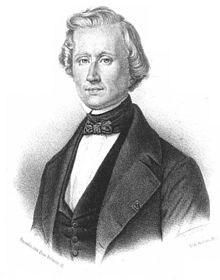
Urbain Jean Joseph LeVerrier


Urbain Jean Joseph LeVerrier was born in St. Lo in Normandy, France on March 11, 1811. As a boy he showed an aptitude for mathematics when he attended school in Caen, but he was turned down from the prestigious Ecole Polytechnique in Paris. In order to help his son, his father sold the family home so that LeVerrier could attend the College de St. Louis in Paris. A year later, when LeVaerrier reapplied to the Ecole Polytechnique his application was accepted, winning the mathematics prize. LeVerrier graduated in the top of his year and briefly took a job working for the chemist Joseph Gay-Lussac.

In 1837 he returned to the Ecole Polytechnique as an astronomy assistant. His first major piece of work was looking in to the stability of the solar system. In 1840 Dominique Arago, the director of the Paris Observatory, suggested he look into the motion of Mercury, which he did. LeVerrier predicted the start of the transit of Mercury of May 1845 to within 16 seconds. Next Arago had LeVerrier look in to the motion of Uranus, which was not moving as predicted. LeVerrier calculated that the perturbations of Uranus' orbit were due to the presence of another planet, further from the sun than Uranus. Unknown to Arago and LeVerrier, in England, John Crouch Adams had previously reached the same conclusion. Adams had sent his work to George Airy, the royal astronomer and James Challis, the director of the Cambridge Observatory. Neither man acted on Adams' findings until after LeVerrier had published his work in June of 1846. After LeVerrier published, Airy attempted to observe the planet, but it was not seen until September of 1846 when what would be named Neptune was observed by Johan Galle and Heinrich d'Arrest in Berlin.

In 1849 he was elected to the French Legislative Assembly. In 1852 he was appointed a senator and member of the Superior Council of Public Instruction on which he served until 1870. When Arago died in 1854, LeVerrier became director of the Paris Observatory. He was removed as director in 1870 but was reinstated in 1873. He was awarded a gold medal by the Royal Society of London in 1868 and 1876. He has craters named after him on the Moon and on Mars and he is one of the 72 names inscribed on the Eiffel Tower.

He died in Paris on September 23, 1877.


References:

Anon.;"Urbain-Jean-Joseph LeVerrier" in Proceedings of the American Academy of Arts and Sciences(1978)13:454-455

Dunkin, E. "M LeVerrier" in The Observatory (1877)1:199-206

Leverington, David; Babylon to Voyager: A history of Planetary Astronomy; Cambridge University Press; 2003

Urbain LeVerrier Wikipedia Entry


Sunday, February 12, 2012

Marcel Gilles Jozef Minnaert

Marcel Gilles Jozef Minnaert was born on February 12, 1893 in Burges, Belgium. His father and mother were school teachers, liberal and supportive of Flemish causes. Minnaert, in his youth was influenced by his uncle, Gerard Minnaert, who was important in the Flemish movement. He grew up in a part of Belgium where Dutch was the common language but all the schools taught in French. After his father's death in 1902 his mother moved the family to Gent, Belgium. Minnaert went to secondary school in Gent and then to the University of Gent, where he studied natural sciences, particularly biology. While a student he was part of a movement to change the language of the university from French to Dutch. He earned his doctorate in biology in 1914.

In 1915-16 he spent a year in Leiden in order to study mathematics and physics. During the German occupation of Belgium he taught physics at the University of Gent, but was forced to flee in 1918, when the Germans left, because he was seen as a collaborator. He relocated to the University of Utrehct, in the Netherlands, where he worked for W.H. Julius who stimulated his interest in solar physics. He finished his second doctorate, this time in astronomy in 1925 the same year that Julius died. Minnaert replaced Julius as the director of the solar spectrograph research project at Utrecht. This was a fascinating time in stellar physics when atomic physics could finally explain what was really happening. Stars, like our sun, are fusing nucleons together, creating new atoms, making the matter that we are made of.

In 1928 he led a successful solar eclipse expedition. In 1940 he published the Utrecht Atlas of the Solar Spectrum and in 1941 he developed the Minnaert function, which is used in the observation of celestial bodies. In 1942, Minnaert, who never hid his liberal political views was taken prisoner by the Germans. He taught physics to his fellow prisoners while he was imprisoned. He was released in 1944. After the war, he returned to the University of Utrecht's observatory and remained director until his retirement in 1963. In addition to his astronomical writings Minnaert also published a physics book that was popular in the Netherlands and was translated, and also a book of poetry dealing with astronomical subjects. Honors won by Minneart include the Bruce medal, presented by the Astronomical Society of the Pacific in 1951 and a gold medal from the Royal Society of London, in 1947. Minneart also has a crater on the moon and an asteroid named after him.

Mineart died on October 26, 1970.


References:

De Jager, C.; "In Memoriam: Marcel Gilles Jozef Minnaert (12 Februarty 1893-26 October 1970)"; Astrophysics and Space Science(1971)10:83-85

Unsold, Albrecht;"In Memorian: Marcel Gilles Jozef Minnaert";Solar Physics(1971)17:3-5

Anon; "Biographies: Marcel Gilles Jozef Minnaert"; online at www.dwc.knaw.nl

Marcel Minnaert Wikipedia Entry


Sunday, January 8, 2012

Sir Frank Watson Dyson

Frank Watson Dyson was born on January 8, 1868 in Measham, England.  His father, Watson Dyson, was a baptist minister.  He spent his youth in Yorkshire and attended Bradford Grammar School. Dyson was elected to a scholarship at Trinity College, Cambridge where he studied astronomy and mathematics, earning the Sheepshanks Exhibition in Astronomy in 1888 and second wrangler the following year. As a fellow at Cambridge he began researching problems in gravitational attraction and in 1891 he was awarded the Smith's Prize.  In 1892 he became the second Isaac Newton student.

In 1894 at the age of 26 he was appointed to be the chief assistant at the Royal Observatory in Greenwich.  The appointment of such a young man to this lofty position gave rise to some criticism, but time showed that Dyson was up to the task.  At the time Dyson started at Greenwich work on the Astrographic Catalogue was already underway and Dyson played an important part in this research measuring the movements of stars.  Dyson remained at the Greenwich Observatory until 1905 when he was appointed Astronomer Royal for Scotland.  In Edinburgh he worked on observing polar double stars, that were not observable from Greenwich.

In 1910 Dyson was appointed Astronomer Royal, and he returned to Greenwich, where he remained until his retirement in 1933.  During his time as Astronomer Royal Dyson devoted himself to the advancement of practical astronomy, stressing the importance of having observations made with the greatest possible care. Innovations attributed to Dyson include the "six pips", the six tones broadcast by many BBC stations to signal the start of each hour.  Dyson is also responsible for organizing the expeditions to observe the 1919 solar eclipse which demonstrated the effect of gravity on light, providing proof of Einstein's theory of relativity.  With the sun's light blocked out by the moon, the stars in the region behind the sun were observed to have moved, caused by the effect of the sun's gravitational field on their light.

Honors won by Dyson during his career include election to the Royal Society in 1901, the Royal Medal from the Royal Society in 1921, the Bruce Medal from the Astronomical Society of the Pacific in 1922 and a knighthood in 1915.  He served as the president of the Royal Astronomical Society from 1911 to 1913 and president of the British Astronomical Society from 1916-1918.  He has a crater on the moon and a asteroid named after him.

Dyson died on May 25, 1939, while traveling back to England from Australia, and was buried at sea.


References:

Aitken, R.G.;"Frank Watson Dyson 1868-1939"; Publications of the Astronomical Society of the Pacific(1939)51:336-338

Jackson, J., Obituary: Frank Watson Dyson; Monthly Notices of the Royal Astronomical Society
(1940)100:238-246

Frank Watson Dyson Wikipedia Entry

Sunday, December 11, 2011

Annie Jump Cannon

Annie Jump Cannon was born on December 11, 1863 in Dover, Delaware, the first of three daughters.  Her father, Wilson Cannon, was a shipbuilder and a Delaware state senator.  It was her mother, Mary Jump, Cannon's second wife, who sparked young Annie's interest in astronomy when she taught her the constellations. Cannon was hard of hearing, but she was able to attend Wilmington Conference Academy and then Wellesley College, in Wellesley Massachusetts where she studied physics and graduated in 1884.  The cold weather of Massachusetts left Cannon often sick and one winter she suffered scarlet fever, which left her deaf in one ear.  At Wellesley she also learned the new art of photography.

After graduation, with few jobs available to a woman and none that interested her, she returned home.  In 1892 she traveled to Europe and with her box camera.  The pictures that she took were used to make a book In the Footsteps of Columbus, that was sold as a souvenir at the 1893 Chicago World's Fair.  In 1894, after her mother's death, Cannon returned to Wellesly as a graduate student in astronomy.  In 1895 she went to Radcliffe College in Cambridge, Massachusetts as student assistant.  She received her M.A. from Radcliffe in 1907.  In 1896 she was hired by Charles Pickering, the director of the Harvard Observatory, to classify stellar spectra.  Pickering was in charge of the project creating the Henry Draper Catalog, a catalog of stellar spectra and had hired a group of women, because their salaries were cheaper then men, to do the calculations necessary to determine the position of a star.

Not long after the project started there arose a question of how to classify stellar spectra.  Williamena Fleming ,who was in charge of the group of women working for Pickering, wanted a simple classification system and Antonia Draper, the niece of Henry Draper, wanted a more complex system.  Cannon incorporated the work of these women in developing her own system, which became the Harvard Stellar Classification System.  The letters O,B,A,F,G,K,M (memorized by astronomy students using the mnemonic "oh be a fine girl/guy kiss me") are the classification system developed by Cannon, starting with O for the hottest, blue-white stars, B for blue stars, A for white stars, F for yellow-white stars, G for yellow stars, K for cooler orange stars and M for the coolest red stars.  This system, with some modifications, is still used today.  Her work, with classifications of 225,000 stars, was published in the 9 volumes of the Henry Draper Catalog.

In 1911 Cannon succeed Fleming as the curator of astronomical photographs at Harvard Observatory.  In 1938 she was named the William Cranch professor of Astronomy.  She was the first woman to receive a doctorate in astronomy from Groningen University in 1921 and the first woman to receive a honorary doctorate from Oxford in 1925. In 1931 she received the Henry Draper Medal from the National Academy of Science.  She was the first woman elected as an officer in the American Astronomical Society and has a crater on the moon named for her.  The Annie Jump Cannon prize is awarded every year by the American Astronomical Society for outstanding contribution by women astronomers, within five years of their doctorate.  She retired in 1940 but continued working at Harvard Observatory.

She died on April 13, 1941.


References:

Hennessey, Logan; "Annie Jump Cannon (1863-1941)"; available at Wellesly.edu

Kuiper, Kathleen, editor; "Annie Jump Cannon" in The 100 Most Influential Women of All Time, The Rosen Publishing Group; 2009

Annie Jump Cannon Wikipedia Entry

Sunday, November 20, 2011

Edwin Powell Hubble

Edwin Powell Hubble was born on November 20, 1889 in Marshfield, Missouri in the home of his maternal grandparents.  A year later his parents John Powell and Virginia Lee Hubble moved to Marshfield.  His father worked in insurance and often moved with his wife and children and rented out the family's house in Marshfield.  In 1895 Hubble moved back into the family home in Marshfield with his mother and siblings, where he started school.  In 1901 the family moved to Wheaton, Illinois, where Hubble went to middle and high school.  In school Hubble was a good athlete and did well in all his subjects, excepting spelling.  Young Hubble was an avid reader and enjoyed the novels of Jules Verne.  In 1906 Hubble began at the University of Chicago, where he earned his bachelors in mathematics and astronomy in 1910.

After finishing his bachelors Hubble went to England, where he studied law, at the insistence of his dying father, at Queens College, Oxford on a Rhodes Scholarship.  He remained in England for three years.  Upon returning to the United States Hubble taught high school mathematics, physics and Spanish, also coaching basketball, for a year.  After a year teaching he returned to his passion, astronomy, and began studying at the Yerkes Observatory at the University of Chicago, finishing his Ph.D. in 1917.  His dissertation was titled "Photographic Investigations of Faint Nebulae"  Hubble served in the United States Army during World War I, rising to the rank of major.  In 1919 Hubble accepted a position at the Mt. Wilson Observatory, in Pasadena, California, where he remained on staff until his death.  During World War II Hubble  worked for the Army at the Aberdeen Proving Ground, in Aberdeen, Maryland, where he worked on ballistics and for which he was awarded the Legion of Merit.

Hubble's arrival at the Mt. Wilson Observatory coincided with the instillation of the Hooker Telescope, a 2.5 meter telescope, which at the time was the largest in the world.  At the time most astronomers believed that the Milky Way Galaxy was the extent of the universe and that the fuzzy objects called nebulae were contained within it.  Using the Hooker Telescope, Hubble was able to show that some of these fuzzy objects contained stars and were much too distant to be inside of the Milky Way.  Hubble showed that some of these objects were in fact galaxies and he devised a method of categorizing them based on their shape, called the Hubble Sequence, which is still used today classify galaxies.  Hubble's most astonishing discovery came from studying the spectra of 46 galaxies in which he showed that the further galaxies were from each other the faster that they were moving away from each other.  Based on this observation Hubble concluded that the universe was expanding at a constant rate (it later was determined that the rate of expansion is actually increasing).  With his colleague Milton Humason, he estimated that the rate of expansion is 500 Km per second per megaparsec.  So a galaxy one megaparsec away is receding from the Milky Way at a rate of 500Km/second (a mega parsec is one million parsecs, each 3.3 light years or about 3.08x10²²meters).  This is called the Hubble Constant and astronomers have been refining the measurement ever since.

Honors won by Hubble include the Bruce Medal, awarded by the Astronomical Society of the Pacific, the Franklin Medal, awarded by the Franklin Institute, and Gold Medal, the highest honor of the Royal Astronomical Society of Great Britain.  He was never awarded the Nobel Prize because it was not till after his death that astronomy was considered a subject for which the Nobel Prize in physics could be awarded and the Nobel Prize is not awarded posthumously. In addition to the Hubble Space Telescope, a telescope orbiting the earth, an asteroid and a crater on the moon are also named after Hubble.  In 2008 the United States Postal Service issued a stamp honoring Hubble.

Hubble died on September 23, 1953.


References:

Christianson, Gale E.; Edwin Hubble: Mariner of the Nebulae; University of Chicago Press; 1996

Anonymous; Edwin Hubble Biography at edwinhubble.com

Anonymous: Edwin P. Hubble at Hubble Space Telescope Website (hubble.nasa.gov)

Edwin Hubble Wikipedia Entry

Sunday, June 5, 2011

John Couch Adams


John Couch Adams was born on June 5, 1819, in Cornwall, England. His father was a tenant farmer and his mother had a small estate. His early companions were the library of books, some on astronomy, that his mother had inherited from her uncle. At a village school in Laneast he learned algebra before the age of 12. Through his teens he avidly read books on mathematics and astronomy and in 1839 he entered St. John's College, Cambridge, graduating in 1843. Soon after graduation he obtained a fellowship and stayed at St. John's as a tutor.

After graduation he directed his attention to the problem of the irregularities in the observed orbit of the planet Uranus. The planet Uranus, visible to the naked eye, had been known since ancient times, but due to its slow orbit it was presumed to be a star. It was not until 1781 that English astronomer William Herschel identified it as a planet. Subsequent observations of its orbit showed that it had an irregular orbit, deviating what had been predicted. Using Newton's law of gravitation, Adams showed that the irregularity in Uranus' orbit was due to the presence of another planet.

In Autumn of 1845 he communicated his finding to James Challis, the director of the Cambridge Observatory, and George Airy, the Astronomer Royal at Greenwich, but neither acted upon his results until after Urbain LeVerrier, a French mathematician, published similar results the next summer. Airy attempted to find the planet but because he was using outdated star charts he failed to recognize it when he saw it, and it was instead first recognized by Johan Galle and Heinrich d'Arrest, working in Berlin, using LeVerrier's results. Precedence of the discovery was given to LeVerrier because Adams' results were not published until after the fact.

In 1851 Adams got a fellowship at Pembroke College, which he kept until his death. Also in 1851 he published corrections of the table of the moon's paralax. In 1858 he took a position of professor of mathematics at St. Andrew's University, but stayed for only one year before taking the Lowedean professorship for astronomy and geometry at St. John's College, Cambridge. In 1860 he replaced Challis as director of the Cambridge observatory. He remained at the observatory till his death. Honors won by Adams include the Copley Medal, from the Royal Society, in 1848 and though offered a knighthood during Queen Victoria's 1847 visit to Cambridge, he refused.

He died on January 21, 1892 at the Cambridge Observatory.


References:

Sheehan, William and Thurber, Steven; "John Couch Adams's Asberger syndrome and the British non-discovery of Neptune"; Records and Notes of the Royal Society(2007)61:285-299

"Prof. John Couch Adams"; Journal of the British Astronomical Association(1893)2:196-197

Obituary in Monthly Notices of the Royal Astronomical Society(1893)53:184-209

John Couch Adams Wikipedia Entry

Sunday, May 15, 2011

Williamina Fleming


Williamina Paton Stevens Fleming was born on May 15, 1857 in Dundee, Scotland to Robert Stevens and Mary Walker. Her father was made gilded picture frames and furniture and died when she was seven. "Mina", as she was called, attended public schools in Dundee and did well in school, advancing to become a student teacher when she was 14. In 1877, she married James Orr Fleming and they emigrated to Boston, Massachusetts. Fleming abandoned his pregnant bride and when she looked for domestic work she was hired by Edward C. Pickering, the head of the Harvard Observatory to clean his home.

In 1880, Pickering was working on a project to classify stars based on their spectra and became upset with the low quality work produced by the young man he hired to do the work. Legend is that Pickering declared that his Scottish maid could do a better job and when she was given the chance she excelled. Fleming had the ability to separate stellar spectra based on their characteristics and do the calculations necessary to determine a star's position. She was made a permanent employee of the observatory in 1881 and was put in charge of the star project in 1886.

She and Pickering devised a system to classify stars based on their spectra and published in 1890. When Pickering wanted to make larger catalog of stars he put Fleming in charge of the group of women he hired to do the calculations. In addition to her work on stellar catalogs, Fleming also was the first to identify that variable stars, stars whose light intensity brightened and dimmed regularly over time, could be identified by bright lines in their spectra. In 1907 she published a list of 222 variable stars, many of which she discovered. During her work she discovered 59 gaseous nebula, over 310 variable stars, and 10 novae.

At the time, Fleming was the foremost women astronomer in America. In 1906, she became the first American woman (and the sixth woman overall) to be made a honorary member of the Royal Astronomical Society. Other honors she received include the Guadalupe Almendaro medal, given by the Astronomical Society of Mexico, for the discovery of new stars and she was made an honorary fellow in astronomy by Wellesly College. She also has a crater on the moon jointly named for her and Alexander Fleming.

She died of pneumonia on May 21, 1911 at the age of 54.


References:

Yount, Lisa; "Fleming, Williamina Paton Stevens" in A to Z of Women in Math and Science; Infobase Publishing; 2008

H. H. M.; Obituary in Monthly Notices of the Royal Astronomical Society(1912)72:261-264

Williamina Fleming Wikipedia entry

Tuesday, May 10, 2011

Cecilia Payne-Gaboschkin


Cecilia Helena Payne was born on May 10, 1900 in Wendover, England. Her father (who died when she was 4) was a gifted musician and a London barrister. She attended St. Paul's Girls School and won a scholarship to Newnham College, Cambridge to study natural sciences. Her interest in astronomy was sparked by attending a lecture by Sir Arthur Eddington on his 1919 expedition which confirmed Einstein's Theory of Relativity. Realizing that there would be no career for her in England other than teaching, she moved to America in 1922.

In America she worked for Harlow Shapley, the director of the Harvard College Observatory. Shapley persuaded her to write a doctoral thesis, even though there was no Ph.D. program at Harvard at the time. In her thesis Stellar Atmospheres (1925) using Harvard's library of stellar spectrums she established that small elements (hydrogen and helium) composed 99% of the chemical composition of stars, earning her the first Ph.D. given at Harvard for work done at the Harvard Observatory. At the time it was believed that stars were composed of the same elements as the Earth, with heavier elements making up the majority and her discovery was thought incorrect. Later she was found to be right, but she had given up the study of stellar spectroscopy.

She became a United States citizen in 1931 and in 1933, on a tour of Europe she met Sergei Gaboschkin, a Russian born astronomer. He returned to the United States with her and they were married in 1934. Because she was a woman, Payne-Gaboschkin was often passed over for promotion and did not become a professor until 1956, at the time the first woman to advance to professorship at Harvard. She served as the head of the Harvard Astronomy Department from 1956-1960 and retired in 1966.

Honors won by Payne-Gaboschkin include the Henry Norris Russell Prize from the American Astronomical Society, Membership in the Royal Astronomical Society, and many honorary degrees.

She died on December 7, 1979.


References:

Gingerich, Owen; "Cecilia Payne-Gaboschkin"; Royal Astronomy Society Quarterly Journal (1982)23:450-451

Smith, Eslke V.P.; "Cecilia Payne-Gaboschkin"; Physics Today (1980)33:64-65

Cecilia Payne-Gaboschkin Wikipedia Entry