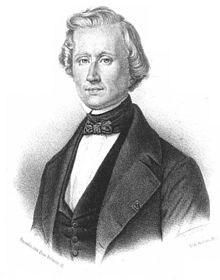
Hermann Minkowski was born on June 22, 1864 in Aleksotas, Lithuania, then part of Poland and the Russian Empire. He was the third son of Lewin Minkowski, a Jewish merchant and his German wife Rachel. When Minkowski was 8 the family moved to Konigsberg, Germany (now Kaliningrad, Russia) to escape persecution and where he attended gymnasium school and showed an ability for mathematics. Minkowski attended the University of Kongisberg starting in 1880. He went to the University of Berlin for a three terms and shared a the Grand Prix des Sciences Mathematiques from the Paris Academy of Sciences with English mathematician Henry J.S. Smith in 1881, when he was 18. Minkowski earned his doctorate in 1885.
After two years of obligatory military service in 1887 Minkowski was appointed privatdozent at the University of Bonn. In 1892 Minkowski became an asOsociate professor at Bonn. In 1894 Minkowski joined the faculty of Zurich Polytechnic, where one of his students was Albert Einstein. In 1902 Minkowski took a chair in mathematics which had been created especially for him at Gottingen University. Minkowski remained in Gottingen util his death.
Minkowski is most remembered for his work on geometry and space-time. In Euclidean geometry there are three dimensions, representing the three dimensions of space. Minkowski incorporated a fourth dimension representing time to the Euclidean system where time and space are interlinked together forming a whole four dimensional system. This four dimensional space is called Minkowski space-time and arises naturally when consequences of relativity are considered.
Minkowski died suddenly of appendicitis on January 12, 1909.
References:
O'Connor, J.J. and Robertson, E.F.; "Hermann Minkowski"; MacTuror; Retrieved from: http://www-history.mcs.st-andrews.ac.uk/
Manhanti, Subodh; "Hermann Minkowski: Founder of Geometry of Numbers"; Dream 2047 Vol.14 (May 2012) p40-42
Hermann Mikowski Wikipedia Entry
Showing posts with label mathematics. Show all posts
Sunday, June 22, 2014
Wednesday, April 24, 2013
Sir Harold Jefferys
Harold Jeffrys was born April 21, 1891 in the village of Fatfield, near the city Sunderland, England, where his father was a schoolmaster and his mother a school teacher at the village school. He attended school in Fatfield and he was awarded a scholarship to study at Rutherford University in Newcastle-upon-Tyne. In 1907 he went to Armstrong College, also in Newcastle graduating in 1910 with distinction in mathematics. He then went to St. John's College, Cambridge earning on of four mathematical scholarships. He became a fellow at St. John's in 1914 and remained there throughout his career.
Jefferys' studies encompass many related fields, including astronomy, pure mathematics, and geophysics. He was particularly interested in seismology and using the records of earthquakes to discern information about the structure of the Earth. By studying the rates at which seismic waves travel through the Earth's crust he was able to determine that it is composed of at least two layers and that the Earth has a molten core. We now know that the Earth's core has molten outer core and a solid inner core. Although his studies advanced our knowledge of the structure of the Earth he remained skeptical of the theory of plate tectonics, the currently accepted theory of movements of the Earth's crust. Much of Jeffrey's work was completed before the advent of artificial satellites and deep ocean drilling used to do geophysical research today.
Jeffery's work in astronomy focused on the planets Neptune and Uranus. In 1923 he proposed that these planets would have surface temperatures of the order of -120 Celsius. This was disputed at the time, but has been proven accurate. He also published a book on probability theory that was influential in that field. Honors won by Jeffry's include election to the Royal Society in 1925, a Gold Medal from the Royal Astronomical Society in 1937 and the Copely Medal from the Royal Society in 1961. He was knighted in 1953.
Jeffrys died on March 18, 1989.
References:
O'Connor, J.J. and Robertson, E. F.; "Harold Jeffrys"; retrieved from history-mcs.st-and.ac.uk.
Mumford, George S.; "Jeffrys, Harold"; in Biographical Encyclopedia of Astronomers; Springer; 2007
Harold Jeffrys Wikipedia Entry
Sunday, March 11, 2012
Urbain Jean Joseph LeVerrier
In 1837 he returned to the Ecole Polytechnique as an astronomy assistant. His first major piece of work was looking in to the stability of the solar system. In 1840 Dominique Arago, the director of the Paris Observatory, suggested he look into the motion of Mercury, which he did. LeVerrier predicted the start of the transit of Mercury of May 1845 to within 16 seconds. Next Arago had LeVerrier look in to the motion of Uranus, which was not moving as predicted. LeVerrier calculated that the perturbations of Uranus' orbit were due to the presence of another planet, further from the sun than Uranus. Unknown to Arago and LeVerrier, in England, John Crouch Adams had previously reached the same conclusion. Adams had sent his work to George Airy, the royal astronomer and James Challis, the director of the Cambridge Observatory. Neither man acted on Adams' findings until after LeVerrier had published his work in June of 1846. After LeVerrier published, Airy attempted to observe the planet, but it was not seen until September of 1846 when what would be named Neptune was observed by Johan Galle and Heinrich d'Arrest in Berlin.
In 1849 he was elected to the French Legislative Assembly. In 1852 he was appointed a senator and member of the Superior Council of Public Instruction on which he served until 1870. When Arago died in 1854, LeVerrier became director of the Paris Observatory. He was removed as director in 1870 but was reinstated in 1873. He was awarded a gold medal by the Royal Society of London in 1868 and 1876. He has craters named after him on the Moon and on Mars and he is one of the 72 names inscribed on the Eiffel Tower.
He died in Paris on September 23, 1877.
References:
Anon.;"Urbain-Jean-Joseph LeVerrier" in Proceedings of the American Academy of Arts and Sciences(1978)13:454-455
Dunkin, E. "M LeVerrier" in The Observatory (1877)1:199-206
Leverington, David; Babylon to Voyager: A history of Planetary Astronomy; Cambridge University Press; 2003
Urbain LeVerrier Wikipedia Entry
Monday, November 7, 2011
James Gregory
James Gregory was born on November 6, 1638 in
Drumoak, Scotland. His father was a
minister and died when Gregory was thirteen.
His mother, whose uncle was a professor of mathematics, schooled the boy
in geometry and had him attend grammar school in Aberdeen, Scotland. With his father dead, his education was seen
to by his older brother David and he attended Marischal College in Aberdeen,
graduating in 1657. Gregory studied
optics and in 1663 published Optica Promota in which he described for the first
time the construction of a reflecting telescope, also called a Gregorian
telescope, honoring Gregory. He was not
able to construct one because he did not have the skills required to prepare the mirrors.
A reflecting telescope is an optical telescope that uses one or more curved mirrors to reflect light from the object being viewed. It was invented as an alternative to a refracting telescope, in which light passes through lenses. Refracting telescopes suffer from the problem of chromatic aberration, in which, due to the fact that different colors of light have different indices of refraction through glass, some details can be blurry and show color blotches. An index of refraction is the ratio of the speed of light through a vacuum over the speed of light through a particular medium, in this case glass, and can used to determine how far a light beam is bent when it travels through one medium to another. The effect of the differences in the indices of refraction is that different colors will have different focal lengths for a particular telescope. Today nearly all large research-grade telescopes are reflecting telescopes. Without lenses, they do not suffer from chromatic aberration and have a wider spectrum of color, due to the fact that some wavelengths of light (particularly UV light) are absorbed by glass lenses. Another advantage of reflecting telescopes is that they can be made larger than refracting telescopes. The largest lens that can be practically created is only 1 meter in diameter, whereas reflecting telescope mirrors have been created that exceed 10 meters in diameter.
In 1663 Gregory went to London, England where he met some members of the Royal Society, including John Collins, Robert Hooke, and Sir Robert Moray. These friends introduced him to an optician named Rieve, who attempted to construct a telescope using Gregory's design, but he was unable to make the parabolic mirror to work to Gregory's satisfaction. Isaac Newton read Gregory's book and the two later corresponded. At that time the European continent was considered the center of mathematics research so in 1664 he left London for Padua, in the Venetian Republic, where he studied mathematics and published two works on proto-calculus, which bolstered his reputation and got him into the Royal Society when he returned to London in 1668. In 1669, with the help of Robert Hooke, he was appointed to a new chair in mathematics at the University of St. Andrews. He taught at St. Andrews for 6 years but did not enjoy his time there. Suspicious of his new ideas and his interest in higher mathematics his masters at the school shunned him and eventually withheld his salary and servants.
In 1674 he accepted a new professorship at the University of Edinburgh. At Edinburgh the university officials were more generous and he had the money he needed to establish an astronomy program. Sadly, in October of 1675 he suffered a stroke while he was showing the moons of Jupiter to his students. He died a few days later at the age of 37.
References:
Chambers, Robert; "Biographical Dictionary of Eminent Scotsmen"; Volume 2; Blackie and Son, 1835
O'Connor JJ and EF Roberson; "Gregory Biography"; at history.st-andrews.ac.uk
Anon; "Biographical Information" for Gregory, James, at nahste.ac.uk
James Gregory Wikipedia Entry
Sunday, June 5, 2011
John Couch Adams

John Couch Adams was born on June 5, 1819, in Cornwall, England. His father was a tenant farmer and his mother had a small estate. His early companions were the library of books, some on astronomy, that his mother had inherited from her uncle. At a village school in Laneast he learned algebra before the age of 12. Through his teens he avidly read books on mathematics and astronomy and in 1839 he entered St. John's College, Cambridge, graduating in 1843. Soon after graduation he obtained a fellowship and stayed at St. John's as a tutor.
After graduation he directed his attention to the problem of the irregularities in the observed orbit of the planet Uranus. The planet Uranus, visible to the naked eye, had been known since ancient times, but due to its slow orbit it was presumed to be a star. It was not until 1781 that English astronomer William Herschel identified it as a planet. Subsequent observations of its orbit showed that it had an irregular orbit, deviating what had been predicted. Using Newton's law of gravitation, Adams showed that the irregularity in Uranus' orbit was due to the presence of another planet.
In Autumn of 1845 he communicated his finding to James Challis, the director of the Cambridge Observatory, and George Airy, the Astronomer Royal at Greenwich, but neither acted upon his results until after Urbain LeVerrier, a French mathematician, published similar results the next summer. Airy attempted to find the planet but because he was using outdated star charts he failed to recognize it when he saw it, and it was instead first recognized by Johan Galle and Heinrich d'Arrest, working in Berlin, using LeVerrier's results. Precedence of the discovery was given to LeVerrier because Adams' results were not published until after the fact.
In 1851 Adams got a fellowship at Pembroke College, which he kept until his death. Also in 1851 he published corrections of the table of the moon's paralax. In 1858 he took a position of professor of mathematics at St. Andrew's University, but stayed for only one year before taking the Lowedean professorship for astronomy and geometry at St. John's College, Cambridge. In 1860 he replaced Challis as director of the Cambridge observatory. He remained at the observatory till his death. Honors won by Adams include the Copley Medal, from the Royal Society, in 1848 and though offered a knighthood during Queen Victoria's 1847 visit to Cambridge, he refused.
He died on January 21, 1892 at the Cambridge Observatory.
References:
Sheehan, William and Thurber, Steven; "John Couch Adams's Asberger syndrome and the British non-discovery of Neptune"; Records and Notes of the Royal Society(2007)61:285-299
"Prof. John Couch Adams"; Journal of the British Astronomical Association(1893)2:196-197
Obituary in Monthly Notices of the Royal Astronomical Society(1893)53:184-209
John Couch Adams Wikipedia Entry
Subscribe to:
Posts (Atom)